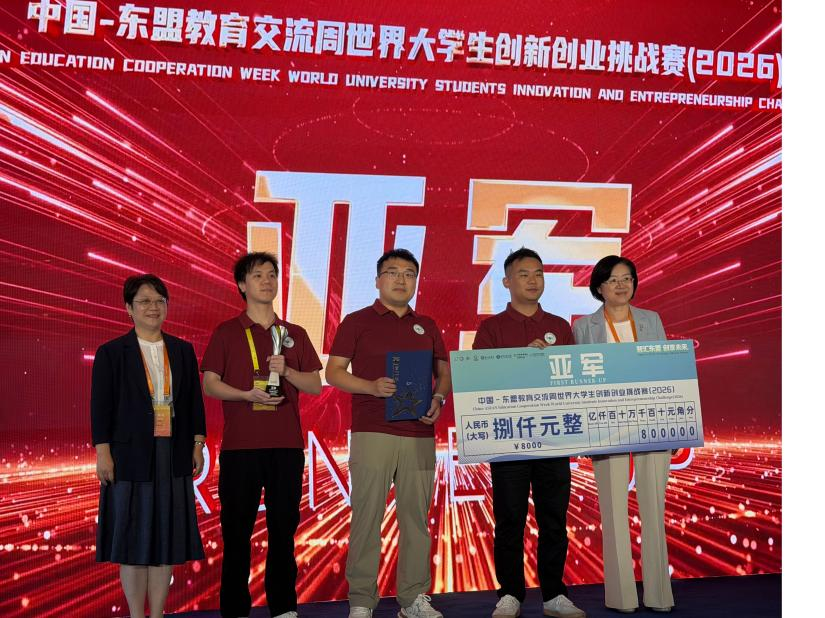
On July 30, the Finals of the World University Student Innovation and Entrepreneurship Challenge, 2026 China-ASEAN Education Cooperation Week, were held in Guiyang City. After multiple rounds of fierce competition, our university's project, "Aurora Chip: Ultra-Low-Loss Slow-Light Metasurface Chip," emerged victorious and was awarded the Runner-up at the Finals.
Targeting industry pain points in optical communications, intelligent sensing, and computing power networks, the "Aurora Chip: Ultra-Low-Loss Slow-Light Metasurface Chip" project has independently developed a new-generation ultra-low-loss slow-light metasurface chip. This innovation overcomes technical bottlenecks of traditional optical devices, such as bulky size, high optical loss, and integration difficulties, providing a miniaturized, high-performance core optical solution for high-speed optical interconnects and optoelectronic sensing systems. Moving forward, the project team will continue to refine its core technologies, accelerate the commercialization of research outcomes, actively explore the ASEAN market, seek cross-border technological cooperation opportunities, and maintain a deep commitment to the cutting-edge optoelectronic chip sector.
As a flagship event of the 2026 China-ASEAN Education Cooperation Week, this year’s challenge was themed “Gathering Wisdom in ASEAN, Innovating for the Future.” It attracted 1,007 projects and 7,656 contestants from 149 universities across 11 countries and regions. Featuring eight major tracks, the competition focused on cutting-edge fields such as the digital economy, advanced manufacturing, and new energy and materials, establishing an international platform for youth exchange, the showcase of sci-tech innovations, and industrial matchmaking between China and ASEAN. After multiple rounds of regional qualifiers and preliminary competitions, four outstanding teams from Peking University, Guangxi University, Nanyang Technological University (Singapore), and Technical University of Madrid advanced to the Finals, ultimately competing for one Champion, one Runner-up, and two Third-place awards.
During the Finals, participating teams delivered project pitches and participated in on-site Q&A sessions, engaging in intense competition over technical innovation highlights, commercialization prospects, and the feasibility of regional implementation in ASEAN. Our university's "Aurora Chip: Ultra-Low-Loss Slow-Light Metasurface Chip" project aligns perfectly with the demand for digital infrastructure development and the growth of next-generation information industries in ASEAN. Its outstanding technological innovation and industrialization value received unanimous praise from the judging panel.

 Home
>
News & Events
>
Events
Home
>
News & Events
>
Events


